
Many of our new customers come from a previous bad experience working with a different company – missed deliveries, formula inconsistencies, or non-existent documentation. Bad choices do not usually become apparent right away; they become evident three months down the line when your first order is rejected by the retailer’s quality control team.
Here, we will provide you with everything you need to check for before committing to a cosmetic manufacturing partner in India, based on the most frequently asked questions by brand owners.
Why the Selection Process Matters More Than the Quotation ?
Another typical problem is the selection of a manufacturer based only on price. It could be assumed that a low quotation indicates an inadequate approach to the testing, sourcing or documentation process.
In essence, the manufacturer becomes the production department for your brand. The weak processes become your burden, not theirs.
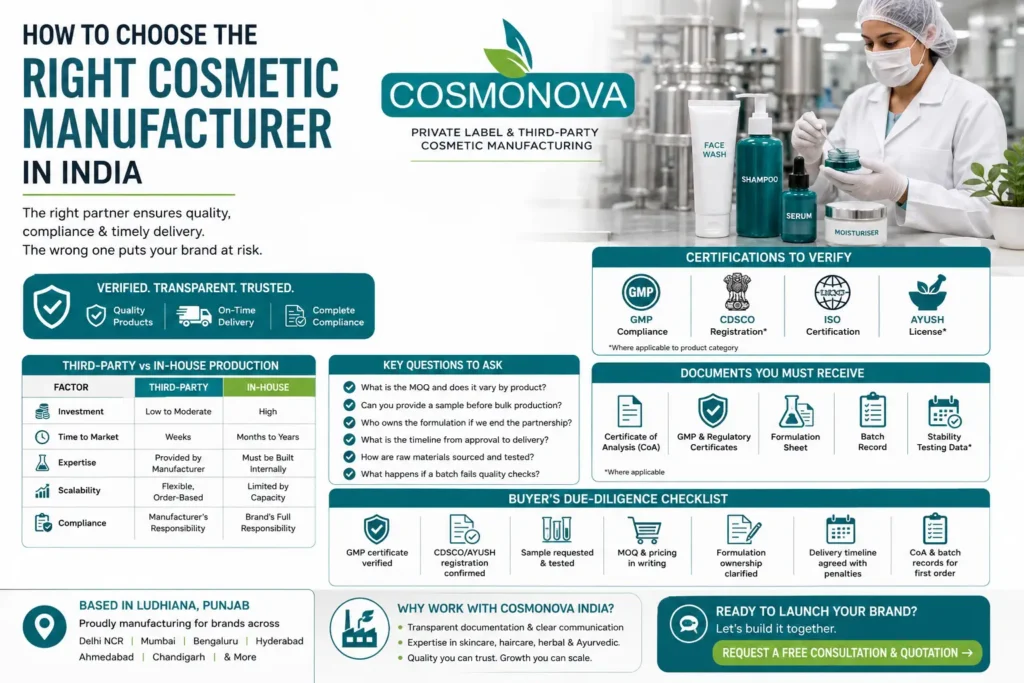
Certifications You Should Actually Verify
The least that you can do is to insist on obtaining documents proving GMP compliance, CDSCO registration for the product line and ISO certification if applicable. Never rely on verbal assurances only.
Legitimate suppliers will not hesitate to provide copies of their certificates. If your potential supplier is reluctant, take it as a red flag.
- GMP (Good Manufacturing Practice) certification for the actual manufacturing unit
- CDSCO registration, where the product category requires it
- ISO certification for quality management systems
- AYUSH licensing, specifically for Ayurvedic or herbal formulations
Third-Party Manufacturing vs In-House Production
Companies tend to ignore the amount of money and time that will be involved in producing products in-house before comparing this option to outsourcing.
| Factor | Third-Party Manufacturing | In-House Production |
| Upfront investment | Low to moderate | High (equipment, licensing, staff) |
| Time to market | Weeks | Months to years |
| Formulation expertise | Provided by manufacturer | Must be built internally |
| Scalability | Flexible, order-based | Limited by owned capacity |
| Regulatory compliance | Manufacturer’s responsibility | Brand’s full responsibility |
For the majority of beauty startups and D2C companies, outsourcing production through a third party is faster and poses less risk, as long as the third-party manufacturer is properly researched.
Questions to Ask Before Signing a Contract
When choosing a third-party manufacturer, these questions reveal more than any marketing brochure will.
- What is the minimum order quantity, and does it vary by product type?
- Can you provide a sample batch before committing to full production?
- Who owns the formulation if we end the partnership later?
- What is the typical timeline from sample approval to delivery?
- How are raw materials sourced and tested before use?
- What happens if a batch fails internal quality checks?
A manufacturer who answers these clearly, without vague reassurances, is usually one worth working with.
Documents Every Manufacturer Should Provide
- Certificate of Analysis (CoA) for each batch
- GMP and relevant regulatory certificates
- Formulation sheet or ingredient declaration
- Batch manufacturing record
- Stability testing data, where applicable
If any of these are missing at the sampling stage, expect delays or disputes once you’re placing bulk orders.
Common Mistakes Brand Owners Make
- Signing before requesting a physical sample
- Assuming lower MOQ always means better value
- Not clarifying formulation ownership in writing
- Skipping a factory visit or virtual facility walkthrough
- Ignoring packaging compatibility with the chosen formulation
After manufacturing products for numerous brands, we’ve seen most disputes trace back to unclear expectations set at the very start, not to manufacturing errors later.
Buyer’s Due-Diligence Checklist
Use this before finalising any cosmetic manufacturer in India:
- GMP certificate verified for the actual production unit
- CDSCO/AYUSH registration confirmed, if applicable
- Sample batch requested and tested
- MOQ and pricing confirmed in writing
- Formulation ownership terms clarified
- Delivery timeline agreed with penalty clauses
- CoA and batch records requested for first order
How Cosmonova India Can Help?
As Cosmonova India located in Ludhiana, Punjab, we deal with all the brand owners located in Delhi NCR, Mumbai, Bengaluru, Hyderabad, Ahmedabad and Chandigarh for the manufacturing of cosmetics on a private label basis. From face wash to shampoos as well as natural/ herbal formulations, all enquiries will start with a clear explanation of all the documentation procedure, sampling procedure and timelines.
Conclusion
Choosing a cosmetic company in India is not just about sourcing – it defines the quality of your products, your compliance standing and reputation among customers. A well-designed due-diligence process, supported by correct questions and paperwork, will ensure that your company is protected way before placing any bulk order.
In case you need help with choosing your manufacturing partner for your next product, feel free to contact us and get a quotation.
Request a Free Consultation & Quotation →
Frequently Asked Questions
MOQs vary by manufacturer and product category, and many suppliers offer flexible starting quantities for new brands. Always confirm this in writing before finalising a partnership.
Timelines typically range from a few weeks for stock formulations to a few months for fully custom formulations, depending on testing and approval stages.
At minimum, expect a Certificate of Analysis, GMP certification, formulation or ingredient sheet, and batch manufacturing records for each order.
Yes, it’s often the most practical route for new brands, since it removes the need for owning production infrastructure or regulatory licensing directly.
GMP certification, CDSCO registration where applicable, ISO certification, and AYUSH licensing for herbal or Ayurvedic products are the key ones to confirm.