
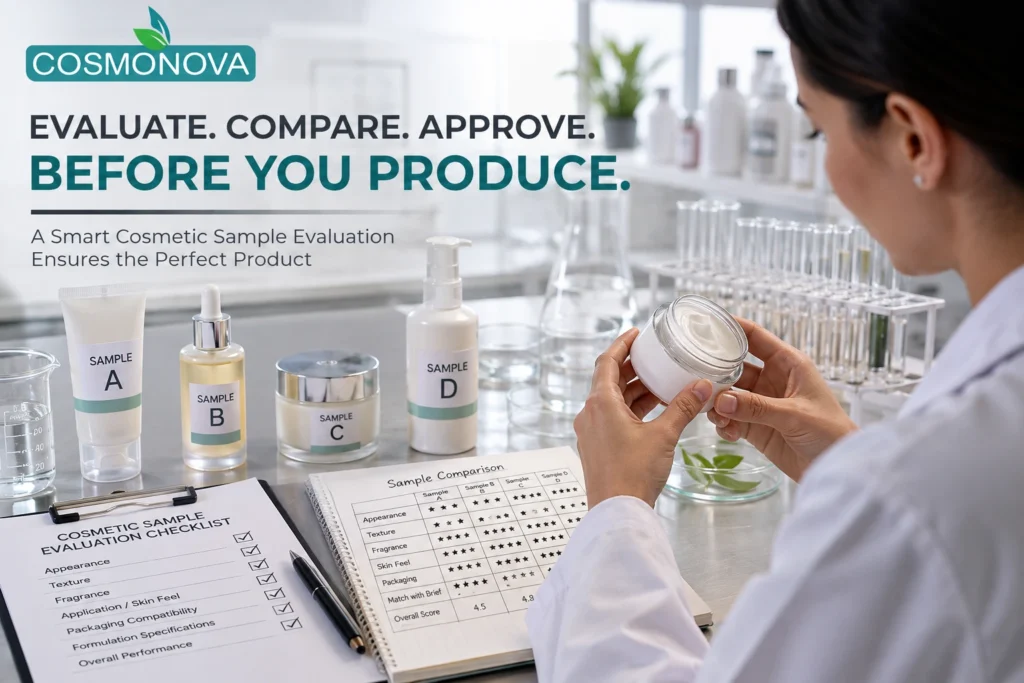
How to Evaluate and Compare Cosmetic Product Samples Before Bulk Production
Nurses who are AHPRA registered, offering medication management, wound dressing, chronic diseases monitoring and post-hospitalization support at the home of participants in Narre Warren area.
The launch of the cosmetic product does not necessarily come to an end when the sample is provided by the manufacturer. In a lot of cases, it is a point when a crucial decision-making process starts. It is necessary for the brand to know whether the sample is really in line with its characteristics or not before proceeding to the mass production of the product.
Cosmetic sample evaluation checklist allows brand owners to evaluate the formulation properly, not relying just on their first impression.
Why Cosmetic Sample Evaluation Matters ?
However, the product may seem visually pleasing in the sample bottle but yet needs improvement with regard to the following: texture, smell, look or consumer experience.
The sample gives you a chance to verify whether the understanding of your product brief by the manufacturer corresponds to your idea.
Moreover, it would be good for you to know that sample approval must always be registered. In case you approve a certain formula or packaging, you have to have some records on it.
1. Check the Product’s Appearance
Begin with the most obvious observation – how does the product look?
Verify:
- Color and uniformity
- Transparency or opacity (where applicable)
- Separation or particulates
- Uniformity throughout the entire bottle
- How it looks after a period of time
This should be consistent with what you would expect based on the product concept and specifications. Any discrepancies should be addressed with the formulation team.
2. Evaluate Texture and Application
Texture can significantly influence how a customer experiences a cosmetic product.
Depending on the product category, assess whether it feels:
- Too thick or too thin
- Sticky or greasy
- Smooth or grainy
- Easy to spread
- Comfortable during application
- Appropriate for the intended product positioning
For creams, lotions, gels and serums, also consider how quickly the formulation absorbs or settles on the skin. For haircare products, evaluate spreadability, rinse feel and the finish left on the hair where relevant.
The objective is not simply to decide whether you personally like the texture. Ask whether it matches the target customer and the product brief.
3. Assess Fragrance Carefully
In addition, the other area in which small differences would make a difference to consumer perception would be that of fragrance.
Assess the quality and appeal of the fragrance. If your brief comes along with a fragrance profile, assess the sample according to the said profile.
Do not accept any sample merely because it smells good. The most important thing here is the suitability of the fragrance for your product.
4. Review the Product Specifications
A sample of the cosmetics should be evaluated based on the formulation criteria, rather than its appearance.
According to the cosmetic type, make sure that:
- Active ingredients
- Base / Excipients
- Consistency
- Fragrance
- Color
- Pack Size
- Product form
- Claims / Positioning
are in accordance with those initially specified by the brand in case any has been modified.
5. Check Packaging Compatibility
The formulation and its packaging should complement each other.
Examine the relationship between the product and its package or dispensing mechanism. Ask if the product can be easily dispensed and if the packaging is suitable for the product.
Take the case of a product having a certain viscosity that requires a dispensing mechanism for practical usage. Packaging must thus be considered along with the formulation and not as a totally separate issue.
Cosmonova India offers both packaging and manufacturing services from one roof. Its product-solutions section also outlines packaging advice on issues relating to the material, packaging, and labeling of the product.
6. Compare Samples Objectively
If you are reviewing samples from multiple manufacturers, create a simple comparison sheet.
Score each sample against the same criteria:
| Evaluation area | Sample A | Sample B | Sample C |
|---|---|---|---|
| Appearance | /5 | /5 | /5 |
| Texture | /5 | /5 | /5 |
| Fragrance | /5 | /5 | /5 |
| Application/skin feel | /5 | /5 | /5 |
| Packaging suitability | /5 | /5 | /5 |
| Match with product brief | /5 | /5 | /5 |
This prevents one strong feature—such as a pleasant fragrance—from overshadowing weaknesses elsewhere.
7. Do Not Approve a Sample Too Quickly
A typical error people make is that they approve of a sample just because it seems appealing on their first try.
Take some time to evaluate the product based on its function and talk to the manufacturer about making necessary adjustments.
Have records for:
- Sample variant or reference
- Request for changes
- Final specifications agreed upon
- Choice of packaging
- Approval date
- Discussion of testing
This will make it easier for you to have a clear starting point for mass production.
When Should You Involve the Manufacturer’s Formulation Team?
Just because the sample doesn’t satisfy your needs does not mean that you must abandon your whole project. This can be sorted out through formulation discussion, which may include changes in aspects such as texture, smell, ingredients, appearance, etc., depending upon the type of product in consideration.
According to Cosmonova India, they offer custom formulations and samples for testing and analysis before offering the final product.
Final Cosmetic Sample Approval Checklist
Before approving a cosmetic sample for bulk production, ask:
- Does the appearance match the agreed specification?
- Is the texture appropriate?
- Is the fragrance suitable?
- Does the product feel right during intended use?
- Are the formulation specifications clear?
- Is the packaging suitable for the formulation?
- Have required changes been documented?
- Are you approving the correct sample version?
- Have relevant quality or testing requirements been discussed?
Make Sample Approval a Proper Business Decision
Cosmetic sample preparation is not just a glimpse of what the finished product will look like. It is an opportunity to bring together brand aspirations, formulation needs, and manufacturing needs.
Allowing sufficient time to assess the sample methodically may enable better communication with the manufacturer to avoid unnecessary alterations to the product in the manufacturing process.
Brands planning to develop a skin care or other cosmetic product could be assisted by Cosmonova India during their product formulation and sampling phase, which would be part of their cosmetic manufacturing services.
FAQ
Check appearance, texture, fragrance, application feel, formulation specifications and packaging suitability. Compare the sample against the original product brief rather than relying only on first impressions.
There is no universal number. If you are comparing different formulations or manufacturers, evaluate every sample using the same criteria so that your decision remains objective.
Yes. Packaging should be considered alongside the formulation because the container and dispensing system need to be appropriate for the product.
Potentially, depending on the formulation and the manufacturer’s development process. Discuss the required changes with the formulation team before approving the sample for bulk production.
Yes. Keep the sample reference, agreed specifications, requested modifications and approval details. This creates a useful reference before commercial production.
A sample may appear satisfactory initially but still have issues with texture, fragrance, packaging or specification alignment. A structured review gives the brand an opportunity to identify and discuss changes before bulk production.